
5/27 “Why I’m Still an Ethnomusicologist.” 《為何我仍是民族音樂學家》
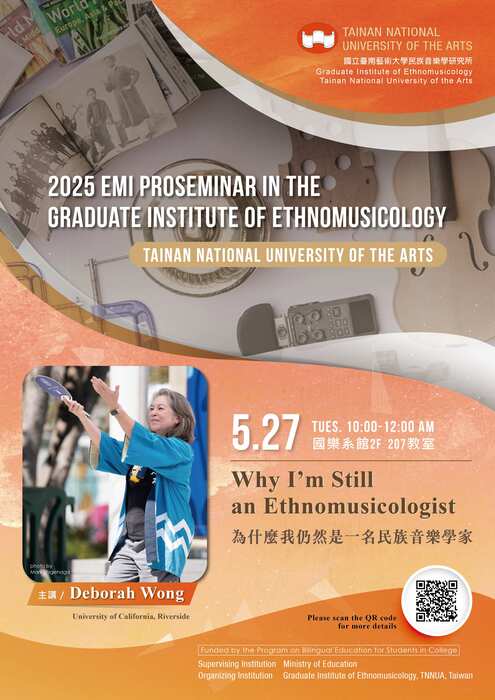
◎◎◎113學年度第2學期專題演講◎◎◎
★時間:114年5月27日上午10-12點
★地點:國樂系館2樓207教室(線上同步)
熱烈歡迎加州大學河濱分校音樂系的榮譽教授 Deborah Wong來訪。
Topic/Title: “Why I’m Still an Ethnomusicologist.” 《為何我仍是民族音樂學家》
Google Meet 會議參加資訊
Link:https://meet.google.com/aup-strh-yiv
ABSTRACT
This presentation is a shadow archive of my late-career, post-retirement thoughts on why I remain committed to ethnomusicology as my disciplinary location. My perspective is unapologetically US American because I have pursued my career almost entirely in US-centered contexts. My stakes are in US-based higher education and public sphere work. Since the 1990s, ethnomusicology has been positioned ideologically as part of corporate multiculturalism. In a post-Black Lives Matter, post-pandemic, post-tenure context, US-based ethnomusicologists are now abruptly in a post-diversity nation… in a new era of political tyranny.
I have repeatedly looked ‘beyond’ ethnomusicology. Performance studies, sound studies, and Asian American Studies have offered essential answers to some of my questions. Yet I still choose ethnomusicology. Rather than focus on the vulnerable weaknesses in the discipline (which many brilliant ethnomusicologists have done over the last few years), I reflect here on the notable strengths and capabilities of ethnomusicology that invite me back to it again and again, including its capacious and voracious ability to embrace ideas from other disciplines, its organically progressive values, its restless self-critique, and its methods for moving between registers of scale. This presentation is my love letter to a permanently imperfect discipline that has repeatedly redefined what ethnomusicologists do.
BIO
Deborah Wong is an ethnomusicologist and Professor Emerita of Music at the University of California, Riverside. She has written three books: Louder and Faster: Pain, Joy, and the Body Politic in Asian American Taiko (2019), Speak It Louder: Asian Americans Making Music (2004), and Sounding the Center: History and Aesthetics in Thai Buddhist Ritual (2001). She served as editor for Nobuko Miyamoto’s extraordinary memoir, Not Yo’ Butterfly: My Long Song of Relocation, Race, Love, and Revolution (2021). Committed to public sector work at the national, state, and local levels, she serves on the board of Great Leap and hosts a weekly radio show titled Gold Mountain for KUCR 88.3 FM in Riverside. She was a member of the Taiko Center of Los Angeles for many years and still dances bon-odori every summer in Southern California Obon gatherings. She is a core member of the collaborative team that recently published the oral history book Riverside Women Creating Change: Stories and Inspiration from Activists and Organizers (Inlandia Institute, 2024).
《為何我仍是民族音樂學家》
這次的發表是我在職業生涯後期至退休之後,針對自己為何仍留在民族音樂學領域所做的深思與紀錄。我的觀點是以美國為出發點,因為我的職業生涯幾乎是以美國的學術與文化背景下展開的。我主要關注的是美國高等教育與社會公共領域的部分。
自1990年代開始,民族音樂學在意識形態上被定位為集體多元文化主義的一部分。在「Black Lives Matter」運動、全球疫情肆虐以及終身教職制度式微之後,美國的民族音樂學家突然發現,自己已置身在一個後多元文化的世界--又或者說,迎來一個獨裁政治的新紀元。
我不斷試圖在這門學科之外找尋出路--表演藝術、聲響以及亞美研究也確實為我問題解惑過--然而我還是選擇了民族音樂學。
比起聚焦於這門學科的脆弱處與缺陷(而且這些其實早就被許多傑出的民族音樂學者深入探討過),回顧民族音樂學的顯著優勢與潛能是件我更想做的事。
對我而言,這門學科最吸引人的地方,在於其他學門的觀點與理論與其具備高度相容性。更甚者,是它渾然天成的進步價值觀、自我批判的精神以及在不同的分析層次之間穿梭對話的能力。
簡歷
Deborah Wong 是一位民族音樂學家,也是加州大學河濱分校音樂系的榮譽教授。她有三本著作:《Louder and Faster: Pain, Joy, and the Body Politic in Asian American Taiko》(2019年)、《Speak It Louder: Asian Americans Making Music》(2004年)以及《Sounding the Center: History and Aesthetics in Thai Buddhist Ritual》(2001年)。她曾擔任日本演員宮本信子《Not Yo’Butterfly: My Long Song of Relocation, Race, Love, and Revolution》 (2021) 這本出色的回憶錄的編輯。她致力於國家、州和地方層級公共領域的工作,並擔任 Great Leap 董事會成員,同時主持每週一次的電台節目《Gold Mountain》,該節目在河濱市的 KUCR 88.3 FM 播出。她多年來一直是洛杉磯太鼓中心的成員,每年夏天在南加州的盂蘭盆節活動中仍參與盆舞。她是合作團隊的核心成員之一,該團隊最近出版了口述歷史:《Riverside Women Creating Change: Stories and Inspiration from Activists and Organizers》(Inlandia Institute,2024)。
計畫名稱:教育部補助 113 學年度大專校院學生雙語化學習計畫-「普及提升學校」
主辦單位:民族音樂學研究所
